
How to Cross-Reference Deep-Groove Ball Bearings Across Major Manufacturers
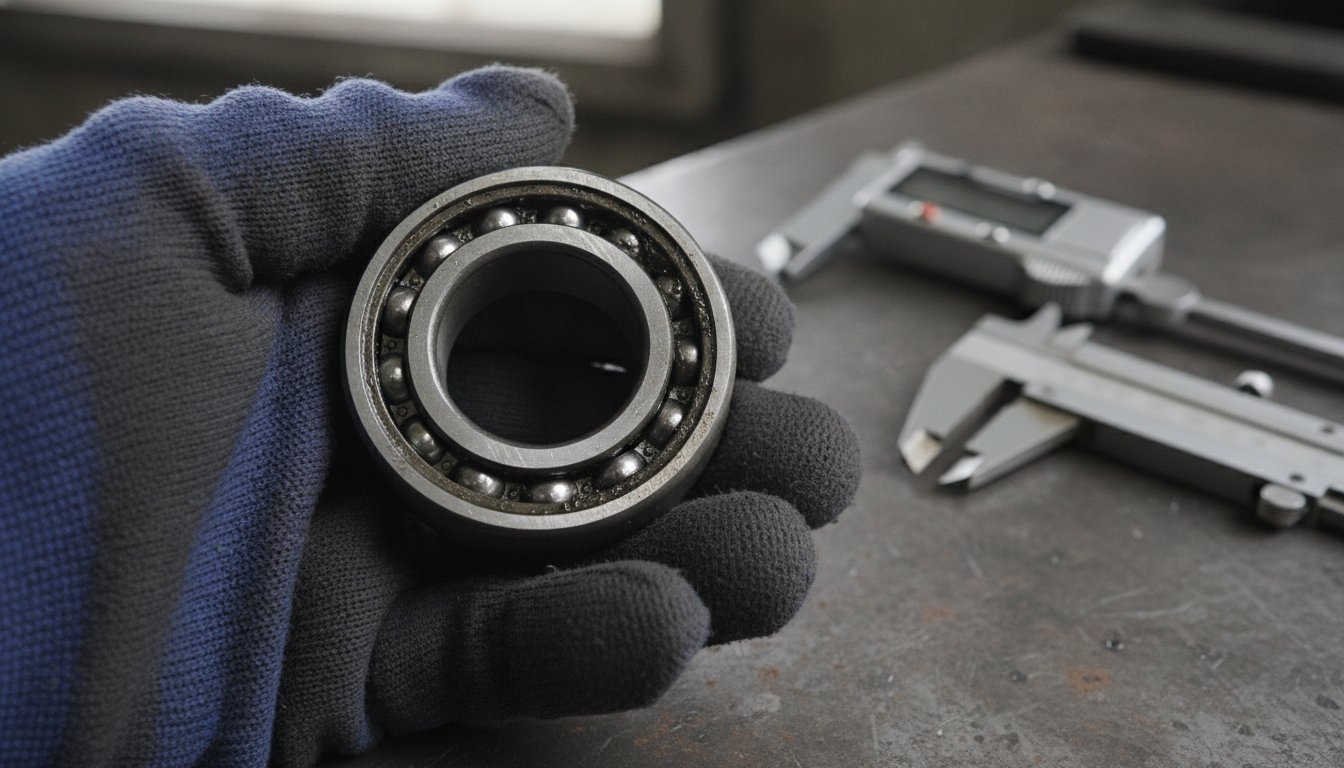
When a machine goes down and the original equipment manual is missing, maintenance buyers often find themselves holding a failed bearing with no clear replacement path. Deep-groove ball bearings are among the most common industrial components, but cross-referencing a part from one manufacturer to another—say, from SKF to FAG, NSK, NTN, or Koyo—requires a systematic approach. Relying on visual inspection alone is risky. Instead, procurement teams need to decode the bearing's physical characteristics, understand basic part number structures, and account for application-specific features.
Start with Physical Measurements and Basic Part Number Decoding
Before attempting to navigate a manufacturer catalog, gather the fundamental dimensions of the bearing in hand. Deep-groove ball bearings are governed by standard boundary dimensions, meaning a standard bearing from SKF will have the same outer diameter, inner diameter (bore), and width as its equivalent from NTN or Koyo. Use a calibrated micrometer or caliper to measure the bore, outer diameter (OD), and width.
Once you have these dimensions, look at the alpha-numeric code etched into the side of the bearing race. While each manufacturer uses proprietary prefix and suffix systems, the core numeric code often follows a predictable structure based on the bore size. For bearings with a bore diameter of 10mm or less, the first digit often represents the bore size directly. For bearings over 10mm, the first two digits typically represent the bore size divided by five. For example, a bearing starting with '6204' indicates a 20mm bore (04 multiplied by 5). The second digit (the '2' in 6204) indicates the diameter series, which dictates the outer diameter and width proportions.
By extracting this core numeric code—such as 6204, 6305, or 6210—you have established the baseline for your cross-reference. A 6204 deep-groove bearing from SKF will share the same basic boundary dimensions as a 6204 from FAG, NSK, NTN, or Koyo. However, the cross-reference process does not end here.
Decode Prefix and Suffix Variations
The core numeric code only identifies the basic bearing geometry. The letters preceding and following the numbers identify critical design features, materials, and internal clearances. This is where cross-referencing becomes complex, as each manufacturer uses different abbreviations for the same features.
Pay close attention to the following attributes when decoding:
- Seals and Shields: Manufacturers use different codes to denote metal shields or rubber seals. A metal shield might be designated as 'Z' by one manufacturer and 'ZZ' for two shields by another. Seals might be designated as 'RS' or '2RS'. You must verify whether the original bearing was sealed, shielded, or open, as this affects lubrication pathways and contamination protection.
- Internal Clearance: Bearings are manufactured with specific internal clearances to accommodate thermal expansion. Standard clearance is often unmarked, but higher clearances are designated by C3, C4, or C5. Fortunately, these clearance designations are largely standardized across SKF, FAG, NSK, NTN, and Koyo, making this one of the easier attributes to cross-reference.
- Cage Material: The retainer or cage holding the balls can be made of steel, brass, or polyamide. If the original bearing used a brass cage for high-temperature or high-speed applications, substituting a standard steel cage bearing could lead to premature failure. Manufacturer suffixes for cages vary significantly and require careful consultation of the specific brand's catalog.
- Radial Play and Precision: Standard deep-groove bearings are normal precision (P0 or ABEC 1). If the bearing has a higher precision rating (like P6 or P5), this will be marked and must be matched exactly to avoid vibration issues in high-speed spindles.
To successfully cross-reference, create a matrix of the original bearing's features. If you have an SKF 6204-2RS1, you know you need a 20mm bore, standard series ball bearing with two rubber seals. You can then look up the equivalent double-sealed 6204 bearing from FAG (often 6204-2RSR), NSK (6204DDU), NTN (6204LLU), or Koyo (6204-2RS).
Account for Application-Specific Features
Even when the dimensions, clearances, and sealing mechanisms match, subtle differences in internal geometry can impact performance. Premium manufacturers often engineer specific internal raceway curvatures and ball complements to optimize load capacity and speed limits for specific applications. A direct interchange based purely on the part number might yield a bearing that fits the shaft and housing but does not handle the exact load profile of the original.
Furthermore, consider the lubrication requirements. A sealed bearing from one manufacturer might be filled with a standard lithium grease, while the equivalent from another might use a polyurea grease. Mixing incompatible greases during relubrication or bearing replacement can cause the lubricant to break down, leading to rapid bearing failure.
When dealing with specialized applications—such as high-temperature environments, washdown areas in food processing, or vibrating screens—relying solely on a basic interchange chart is insufficient. The operating environment dictates the necessary cage material, seal material (such as Viton versus NBR), and grease type. Always document the operating temperature, speed, and load conditions when sourcing a replacement.
Cross-referencing deep-groove ball bearings requires translating a physical component into a set of standardized dimensions and proprietary codes. If you are dealing with an unidentified bearing or need to match a specific manufacturer's specification across alternative brands, reaching out to a knowledgeable industrial parts distributor can help you navigate the interchange tables and ensure the replacement meets your exact application requirements.
Need a quote on a specific part?
Request a Quote